

Developments along the region's main energy arteries significantly limit the export capabilities of Saudi Arabia, increasing transport costs, lengthening delivery times, and heightening concerns over a new surge in international oil prices.
Bab el-Mandeb out of play, dead end for Saudi exports
The deterioration of the security situation in the region has effectively restricted the use of the strategically vital Bab el-Mandeb Strait, through which approximately 12% of seaborne oil shipments and nearly 8% of global LNG trade transit.
This development deprives Saudi Arabia of one of its most important export corridors, forcing Riyadh to seek alternative solutions to secure navigation.
In this context, more than 40 countries participated in an international meeting to establish a maritime defense coalition, while, according to available information, 14 states, including Turkey, Egypt, and Pakistan, appear to support the initiative.
The Suez Canal is not enough, delays up to one month
With Bab el-Mandeb facing severe restrictions, the only reliable alternative for Saudi exports remains the Suez Canal.
However, its limited depth does not allow the passage of fully loaded supertankers.
For this reason, large tankers are forced to offload part of their cargo, which is transported via the Egyptian SUMED pipeline toward the Mediterranean.
Despite these solutions, existing infrastructure cannot replace the approximately 3.5 million barrels per day that transited through Bab el-Mandeb, while for Asian importers deliveries are now delayed by 20 to 30 days, as many cargoes are forced to follow the route around Africa.
Blow to production too, Saudi Aramco suspended operation of major refinery
Pressures are not limited to transport alone.
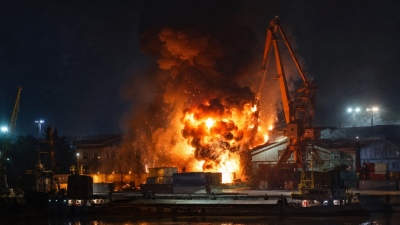
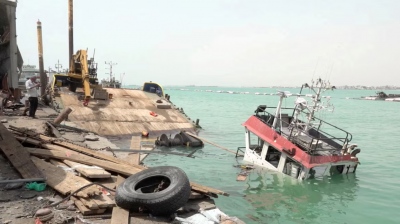
Saudi Aramco proceeded with the suspension of operations at its refinery in Jeddah, with a capacity of approximately 400,000 barrels per day, following attacks on energy facilities.
This development reduces the country's production capacity and reinforces pressures on both the crude oil market and refined products.
New headache in the Black Sea as well
At the same time, problems are recorded in oil exports through the Black Sea.
Attacks on critical infrastructure have impacted transport via the Caspian Pipeline Consortium (CPC), through which approximately 80% of Kazakhstan's oil exports are handled, meaning nearly 1.5 million barrels per day.
The temporary shutdown of terminal facilities led to a significant reduction in Kazakhstan's production, placing an additional burden on global supply.
The US sees pricier gasoline, limited margins for intervention
Although international Brent prices currently remain in the region of 80 to 90 dollars per barrel, pressures have already begun to pass into retail fuel markets.
In the United States, the average price of gasoline now exceeds 4 dollars per gallon, while in certain states it touches as high as 5.65 dollars.
At the same time, the significant reduction in commercial oil inventories limits the margins of the American government to intervene effectively to hold down prices.
Skyrocketing transport costs, freight rates and insurance premiums doubled
The energy crisis is now reflected in the cost of maritime transport as well.
Freight rates and insurance premiums are rising rapidly, while the cost to transport a 270,000-ton cargo of oil from the Saudi port of Yanbu to Asia has increased from 32 to 67 dollars per ton, more than doubling transportation expenses.
For Asian importers, one-month delays entail significant financial losses and an additional burden on the supply chain.
Asia managed to prepare, Russian and Iranian oil in focus
Certain countries in Southeast Asia appear to have moved proactively.
During periods of de-escalation, they significantly increased purchases of Iranian oil, creating stockpiles in anticipation of a potential new crisis.
At the same time, states such as Sri Lanka, the Philippines, South Korea, and even Japan entered into supply agreements for Russian oil, diversifying their supply sources.
Meanwhile, demand for Russian Urals remains strong, particularly from India, while the discount relative to international benchmarks has narrowed significantly.
Europe facing new energy blow
The greatest concerns are recorded in the European Union, where even without physical oil shortages, rising costs of energy, transportation, and petrochemical products threaten to further burden industrial production and inflation.
In this environment, Brussels is examining, within the framework of the 21st sanctions package, the possibility of releasing frozen cargoes of Russian oil without remitting the relevant revenues to their owners, a move Moscow characterizes as illegal and equivalent to asset confiscation.
Brent up to 150 dollars if Hormuz closes
Analysts warn that if the situation in the Middle East deteriorates further, oil prices will move to significantly higher levels.
In the baseline scenario, Brent is estimated to move between 95 and 105 dollars per barrel.
If export losses for Saudi Arabia reach 2 to 3 million barrels per day, prices may approach 110 dollars.
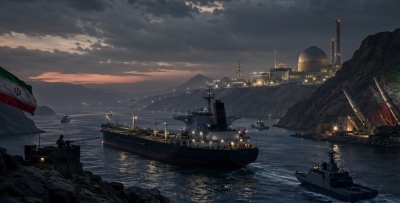
In the extreme scenario of a complete halt to navigation in the Strait of Hormuz, it is not ruled out that Brent could surge even into the 130 to 150 dollars per barrel range, paving the way for a new global energy crisis.
www.bankingnews.gr







Σχόλια αναγνωστών